The meter is moving and nothing is running
Most hidden leaks announce themselves through the water bill or the meter, long before a stain appears. If the numbers rose and nobody changed their habits, or the meter dial keeps turning with every tap shut, water is going somewhere. The question is where, and the answer decides what kind of repair you need.
A leak inside a wall, under a floor, or in the yard does not leave much of a trail. You can narrow it down yourself in about half an hour, and the result will tell the plumber where to start.
A 30-minute meter test
- 1Turn off every faucet, appliance, and ice maker. Make sure no one flushes a toilet.
- 2Find the meter box, usually near the curb at the front of the property. Lift the lid and look for the small low-flow dial or triangle that spins when water moves.
- 3If it spins, or if the reading changes after 30 minutes, water is leaving the system.
- 4Next, close the main shutoff valve at the house and check the meter again.
- 5If it still moves, the leak is on the service line between the meter and the house. If it stops, the leak is inside the house.
- 6Leave the utility's own valve at the meter alone. It belongs to the city.
Leak detection in Downey, CA is the work of locating a hidden water leak with listening equipment, thermal imaging, and pressure testing so the repair opens as little as possible. It answers one question, where, and then hands you an accurate estimate for the fix.
Emergency leak detection: when a hidden leak cannot wait until morning
Most leak calls can wait for the next open visit. Some cannot. Treat it as an emergency when the meter dial keeps spinning with every tap closed, when a ceiling stain is spreading or dripping, when you hear water running inside a wall or under a floor, or when water shows up in the yard or garage and you cannot see where it starts. A leak that is soaking drywall, subfloor, or insulation costs more every hour it runs.
The City of Downey's own meter-leak page says a detected leak should be repaired within 48 hours. That is a short window for a hidden leak, which is why we start with a pressure test and acoustic listening, mark the exact spot, and quote the repair before anything is opened.
The first five minutes
- 1Close the main shutoff valve. The City's leak-finding pages say it is usually in the front yard, in the garage, or near the water softener.
- 2Run one faucet to confirm the water is off, then look at the red flow triangle on the meter. If it still moves, the leak is between the shutoff and the meter.
- 3Switch off power to any wet area you can reach safely, and stay away from outlets near standing water.
- 4Photograph the stain, the meter, and the wet area before you move anything.
- 5Call the line and tell us what the meter did with the main closed. That one answer sets the plan.
With the water off, a hidden leak stops growing, so the call turns from a rush into a diagnosis. We locate the leak, state the price of the repair, and open only the section that failed. If the trace points under a concrete floor, the next step is our slab leak service, and if it points to the yard it is the water line.
Need a plumber right now?
The line is answered at any hour. Describe what the water is doing and we will say what to do first.
Methods, and when each one fits
| Method | What it finds | Best for |
|---|---|---|
| Meter and pressure test | Whether water is leaving, and which section of pipe | The first step on nearly every call |
| Acoustic listening | The sound of water escaping a pressurized pipe | Buried lines, slab leaks, walls |
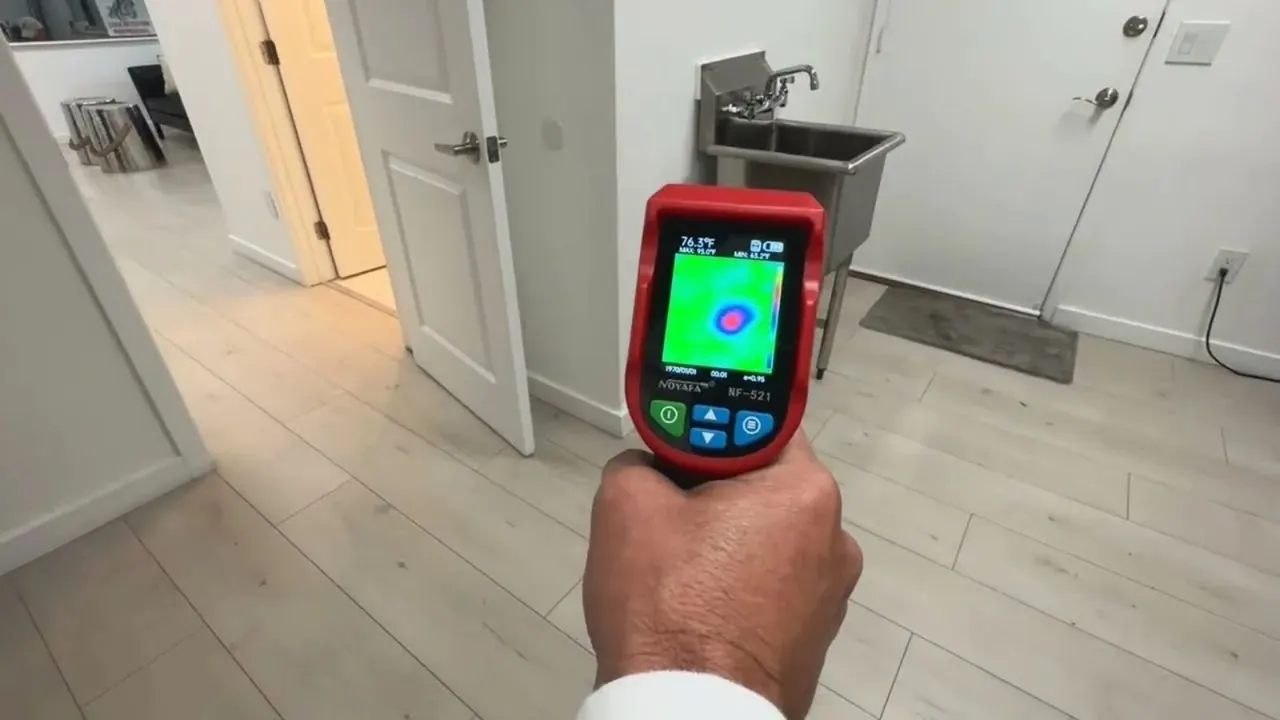
| Thermal imaging | Temperature differences from hot-water leaks or damp materials | Hot lines, radiant paths, ceilings |
| Camera inspection | Cracks and breaks inside drain lines | Drain and sewer leaks |
| Dye and moisture checks | Fixture-level leaks and damp materials | Toilets, tubs, around shower valves |
Water bill climbing for no reason?
Run the meter test, then call. Tell us what it showed.
What the local numbers tell us
The City of Downey Water Division supplies the city and bills each address by meter, so the meter is the first witness. The city's Utilities Division also says it handles leak investigations and flow and pressure testing for customers, so ask it about the meter side before anyone digs.
It also targets pressure of about 65 psi at the water yard. Higher pressure pushes more water through a pinhole, so a leak in a house at the high end of the range loses more each day than the same leak at a lower pressure.
Roughly 13,400 of Downey's 36,000 homes date to the 1950s, with more from the 1940s and 1960s. Homes of those ages have had decades of use, which makes supply-line corrosion, failed valve stems, and aging fittings the ordinary suspects. A leak is more likely to be wear than a freak event, and that is useful to know when you weigh a spot repair against a larger plan.
Hard water adds scale inside older pipes and around valves. Scale narrows the pipe and, over years, accelerates pitting at joints. We note it when we see it, because it affects what we recommend afterward.
What leak detection does not do
Detection finds the leak. It does not repair it. A repair is a separate job, and depending on what the tracing shows, it may be a small patch, a replaced section, or something larger such as water line repair and replacement or a full repipe.
We also will not guess. If the equipment cannot isolate a leak with confidence, we say so and suggest the next step instead of opening a wall on a hunch.
After a repair, the California Plumbing Code, built on the Uniform Plumbing Code (UPC), expects the water piping to be tested and proved tight at working pressure. We run that test before anything is closed up, so you are not trusting a patch you cannot see.
What happens on the visit
Interview
When the problem started, what you have seen, and what the meter did.
Isolate
Pressure testing narrows the leak to a section.
Pinpoint
Listening or thermal tools confirm the spot.
Report
You get the location, the cause, and a repair price.
What affects the price of finding a leak
Insurance note: many homeowner policies cover the cost of tearing out to reach a sudden leak, but not repairs for wear or slow seepage. Ask your insurer before work begins, and photograph any damage first.
A high water bill or a running meter, and what to do before you call
A water bill that creeps up with no change in how you live, a utility alert about a possible leak, or a meter that turns when nothing is on are the most common reasons people call us for leak detection. They point to the same question. Is water leaving the pipes somewhere you cannot see?
Start with the meter test. Close every fixture and appliance, find the main shutoff, and look at the meter. If the dial or flow triangle still moves, water is leaking.
Then close the main. If the meter stops, the leak is inside the house. If it keeps moving, the leak is in the line between the meter and the house, and our water line repair page covers the fix.
| What the meter does | Where the leak is | Next step |
|---|---|---|
| Moves with the main open, stops with it closed | Inside the house or under the slab | Leak detection, then repair |
| Keeps moving with the main closed | The line from the meter to the house | Locate and repair the line |
| Stops with the irrigation valve closed | The sprinkler system | Locate the leaking zone or valve |
A wet ceiling or a stain on a wall
A stain on a ceiling means water is travelling. It can drop from a bathroom above, a supply line in the attic, a drain, or a roof leak, and the wet spot is often not under the source. Put a bucket under any drip, take a photo, and close the main if the stain is spreading.
We find the source by trace and moisture readings, then open the smallest section needed to fix it. If the water comes from a roof, we will say so, because that is not a plumbing repair.
Leaks under the house and in crawlspaces
Homes on a raised foundation let us look at supply and drain pipes from below, which often means a leak can be fixed without cutting into a floor. Tell us whether your home sits on a slab or a raised foundation when you call, because it changes the method and the quote. Slab homes are covered on our slab leak page.
Sprinkler and irrigation line leaks
Irrigation lines are separate from the pipes inside your home, and they leak in their own ways, such as a cracked valve, a broken riser, or a wet strip of lawn that never dries. To check, turn off the irrigation valve and run the meter test. If the meter stops, the leak is in the sprinkler system. If it keeps moving, the leak is elsewhere.
We locate the failed section and tell you what the repair looks like. For pools and spas, we test the water supply and fill lines that feed them. The pool shell and its equipment are a pool contractor's work.
Duplexes, triplexes, and small apartment buildings
In a building with several units on one meter, the first job is to separate the common lines from each unit. We close valves section by section, watch where the meter stops, and then listen to the section that loses water. Landlords and property managers should tell us the number of units and whether each has its own shutoff. For larger sites, see business plumbing.
Leak detection questions from Downey
Run the meter test in the box above. If the meter moves with every fixture off, water is leaving somewhere. Closing the main valve at the house tells you whether the loss is inside the house or on the line between the meter and the house. Then call, and we will trace the exact spot.
Acoustic listening gear picks up the sound of water escaping a pressurized pipe. Thermal imaging shows temperature differences from hot-water leaks or damp materials. Pressure testing isolates which section of pipe is losing water. We use the least invasive method that answers the question.
The purpose is to avoid that. Tracing narrows the leak to a small area, so if a repair needs access, it is a small opening instead of a large one. We tell you where we plan to cut before we cut.
Usually not. A running toilet is a flapper or fill valve problem, and a dye test confirms it. Put a few drops of food coloring in the tank and wait. If color shows in the bowl without flushing, the flapper is leaking. A toilet repair and installation usually fixes it.
Often, yes. A slow leak that adds a few dollars a month may not be worth chasing right away. A leak that runs day and night is different, because the bill grows and the wet material around it keeps taking damage. We can tell you which category you are in after the meter test.
Yes, with acoustic and thermal methods. The repair is its own subject, covered on our slab leak detection and repair page.
Yes, the same 24/7 line covers Downey and its neighbors. ZIP codes 90240, 90241, and 90242 are all inside the Downey service area.
Yes, with acoustic listening and pressure testing on the isolated line. Plastic carries sound differently from metal, so we confirm the spot from more than one reading before anyone digs.
Run the meter test with every fixture closed. If the meter moves, close the main and call us. Keep the alert and any bill that shows the rise, because they help date the leak.
No. A pinpoint visit is for the case where you do not know. Tell us what you saw, such as a wet spot, a stain, or a meter reading, and we plan from there.
Yes. Tell us the access and the timeline, and we will say what a leak check covers. Say so when you call so the visit is planned around it.
If the leak turns out to be from a failing tank, our tank heater repair service takes it from there. For pipes that have split outright, see burst pipe repair, and we run leak calls in Santa Fe Springs as well.
Downey is in Los Angeles County, and the City of Downey Water Division reads meters on a two-month cycle, which lets a slow leak run a long time before a bill shows it. Homeowners from the Columbia Memorial Space Center to the Firestone Boulevard blocks near Stonewood Center can run the one-hour meter test and call the city or us with the result.
Losing water somewhere?
Call the Downey line. We will help you narrow it down on the phone first.
☎ Call (719) 530-4349